The car in 2026:
VW Golf GTI Mk1, 1977
Start #21


Follow our journey in 2026
This year’s edition of the Rally Monte Carlo Historique (RMCH) is rather different from previous years, with the main changes being:
• Closed roads. Until this year, we have been driving primarily on roads open to the public, offering many surprises and challenges. The safety of participants as well as the public has sometimes been at risk, but from 2026 all stages will be on closed roads.
• Shorter stages. We have normally been given stages of 15–40 kilometers, but these have been reduced to approximately 10 kilometers. The time between each stage is quite tight, so the opportunity for service teams to provide support is rather limited.
• Higher speed. In principle, we are driving on the same roads that the WRC 2026 will be using—just a few days ahead of them. Compared to previous years, our average speed has been significantly lower. This year, however, we will be running mostly at an average speed of around 60 km/h (compared to approximately 90 km/h for the WRC). This again triggers additional safety measures.
• Safety. Helmets are mandatory, along with fire-resistant clothing and shoes.
• Classification. Historically, we have been competing against cars of similar age, but from this year we are offered only two categories, namely “High speed” and “Moderate speed,” the difference being approximately 5 km/h.
All in all, the rally will be faster, tougher, and certainly more competitive—for better and for worse. Better in the sense that we will be on a more equal level, with limited benefit from large service teams; worse because older cars will compete against more modern cars without any handicap system.
But it is what it is—we all need to adapt, prepare, and do our best!
The team:
Kaare Krane, pilot
Terje Thorstensen, co-pilot
Frode Bjerke, service
Harald Hagen, service

2025
Retrospective

Preparations at home


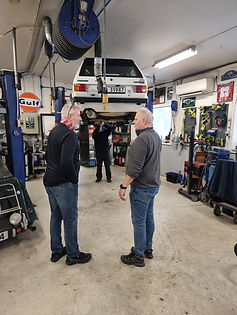
Way before ending the 2025 season at home, we started planning a full run-through of the car as well as any equipment revision. To me, this is actually the fun part, taking some time to think through what’s important and what’s not!
Approaching end January, we have been through the following revisions:
-
replaced rear brakes discs and installed new trip sensors
-
replaced brake fluid
-
normal engine service
-
revision of the electrical system
-
new headlights and fog lights
-
windshield replaced
-
new asphalt & winter tires
-
modified under body/engine shields
-
double set of fuel pumps
-
new Sparco seats
-
·ew rear hatch + window
-
intercom integration with helmets
... and so, so much more. I have no idea of how many hours Terje and I have spent on the car, but my humble thanks to Bråthen Bil and Kvam Auto and Frode/Harald for their tremendous support – in terms of work, ideas as well as motivation. Would not have made it without them!
Whilst prepping the car is made at the garage, the proof is in the testing of the car. And that we did on January 10th participating at the Norwegian Winter Challenge. And that went well; 1st in class, fastest on driving tests, and 2nd overall! Looking good so far!


Training in France

Next step is preparing for transportation and transfer of car and equipment to France. We’ll take the rally car on a trailer down to Provence and our tow car will be our service car boarding the Oslo-Kiel ferry on Thursday 22nd January.
The plan is as follows:
22.01: Oslo-Kiel
23.01: Kiel-Kronberg (575 km)
25.01: Kronberg-Valence (800 km)
26/27.01: test drive
28.01: Valence-Nice (370 km)
29/30.01: test drive
31.01: scrutineering and documentation Monte Carlo
01.02: RMCH start, Monte Carlo
The idea is to have some days up in mountains to test the car and equipment. During these days we will check that the car is working as it should, i.e. the trip will be calibrated and tested on different tires, the tires will be tested on different surfaces and we need to familiarize ourselves with the roads. We know that we may get snowy and slippery roads and temperatures below zero at night and above during the day. Conditions may change quickly, and it is really a lottery what we get next day.
And; we need the right mindset when we start off in Monte Carlo!

Wrap-up and return home

The Rally
Eligible cars are defined by the organizer, the Automobile Club de Monaco (ACM). In principle, they must be similar to cars that participated in the original Rallye Monte-Carlo back in the day, i.e. up to model year 1986. Upon entry, each car must be fully documented and verified in compliance with ACM regulations, and will be inspected again during scrutineering before permission to start is granted.
This year, approximately 250 cars will take part. They will start from Monte-Carlo, Torino, Barcelona, Reims, Bad Homburg and/or John O’Groats (Scotland), before gathering in Valence on February 2nd. After completing 18 special stages, the rally will finish in Monte-Carlo in the early hours of Saturday, February 7th. Depending on the starting city, the total distance will range between 2,038 and 3,544 km.

Sunday, February 1st / Monday, February 2nd
Starting off the ramp as from 23 p.m., we’ll be heading for Gap (via St. Andre-Les-Alpes and Selonnet) where we hope to get some hours of sleep before we head on to Laragne-Monteglin, Buis-Les - Baronnies, and Crest ending the day in Valence no later than 2.30 pm on Monday February 2 nd .
Cars are then checked again, registered and electronic tracker installed before parked in parc fermè for the night.
Tuesday, February 3rd
Today, the pace quickens, and it all gets “fast & furious”!
The first car starts 7 am and as #21 we’ll start 21 minutes later. 3 stages await up in the mountains east of Valence where we’ll climb Col d’Echarasson (1.146 msl) and Col de Tourniol (1.145 msl). We shall be prepared to faceing anything from full winter to spring!
SR 1 is kind of “getting rid of the cobwebs”, whilst SR 2 looks rather straight forward. However, SR 3 covers 13 hairpins challenging the average speed (63 km/hr). And, when catching up, we may not exceed the average speed with more than max 10%. If doing so, we’ll heavily penalized! Consequently, no braking through the curves to maintain speed….
Around noon, we’ll be back in Valence for a rest, and then off again 90 min later to do the 3 stages once more.
The day ends back in Valence around 6 p.m. 3.87 km done!
Wednesday, February 4th
Today, we rush off again out of Valence at 8:21 am for 2 new stages. Today’s route is on the western side of the river Rhine. SR 7 starts just outside the village St.-Pierreville heading for La Pervenche via Issamoulenc. 12 hairpins. Max alt 933 msl.
SR 8 starts at Lachamp-Raphaël and ends up at Burzet. Looks kind a straightforward with a few hairpins, but staring point is at 1.360 msl so who knows what awaits us.
Having completed the stages, we gather at Vals- de- Bains around 12:30 am. Now, when the initial 8 stages have been completed, the starting positions are being revised according to the performance/results. So, when we head off again 90 min later, the starting order will be different, and this order will be maintained until the rally is finished.
Now another 2 more stages lie ahead of us, the first one staring at Saint-Andéol-de-Vals. Doesn’t look too bad, but as the speed is rather on the low side, I guess there are some surprises around the corner! Ending up at Col de Sarrasset, we head off to the final stage of the day, SR 10. It is actually the SR 7 once more – unless changes are announced. Which the often do!
We return to Valence again sometime around 6 pm. 296 km more completed!
Thursday, February 5th
The track today is a little longer that yesterday, but faster….
We start off from Valence around 8:30 am facing 3 stages again to the east side of Valence, but today a little more southwards.
SR 11 starts at Les Noniéres and ends at Chichilianne after 14,4 kms. I see this as a challenging one, it’s long (14,4 kms), has a number of hairpins (7) and with the highest point is at 1.402 msl. we’ll have some hilly areas to drive through.
SR 12 is a little shorter, but again – we start at 1.036 msl in Le Château, passing over Col de Carabes (1.2659), ending up at La Bâtie-des-Fonts at 891 msl. Road surfaces could be a surprise. SR 13 staring at Col de Chamauche will be another challenge. We start the clock at 1.037 msl and run down the valley through 7-8 hairpins. On paper it looks not too bad, but in reality, it is quite hilly, up and down on tricky roads. We’ll see – this one is not to be underestimated.
Returning to Valence around 4 pm. 312 km done. Early dinner today and the last evening in Valence!!

Friday, February 6th
The long day – the longest of the entire rally.
The loooong day – the longest of them all. First some 438 km to get to Monaco, and then another 148 km during the night in the mountains above the city of Monte-Carlo.
On our way to Monaco, we have 3 stages. SR 14 starts at Aucelon, takes us over Le Devés, into the vally, and up to Col de Pennes (1.040 msl) and the then down the valley to Barnave. 16 hairpins and a lot of fun. I hope!
SR 15 starts at Bréziers (1.061 msl) and takes us over Col des Garcines (1.250 msl) and down to Selonnet. 13,4 km. Not too many hairpins, but high average speed (65 km/hr).
SR 16 Auzet to Esclangon. 14,4 km. Not too tricky, but this is when we start to get kind of tired. Knowing when we arrive in Monte-Carlo, there are some more night stages to drive… We’ll pass through La Turbie for the traditional coffee before eventually cruising in to Monte-Carlo.
Now, we have some hours of rest before the last 2 stages awaits. But be not mistaken; there will be no sleep – adrenalin will be high and we start thinking about the final legs remaining in the hills above Monte-Carlo. We check the car once more, drink coffee and try to keep the spirits high!
We head out of town around 9:30 pm passing in front of the casino and the glory of Café de Paris before leaving through the dark backstreets of the city. The final game is on! Just 30 sec between the cars now – just to keep the heat on!
SR 17 starts at La Bollène-Vésubie. 15 km of narrow, hilly and pretty sharp turns. It is a f…. nightmare – literally. 12 hairpins, and altitude from 719 msl to 1.650 msl. With the average speed defined it is almost impossible to keep up. But we will try!
SR 18: La Cabanette – Col de Braus. 13,6 km. It is the same thing all over again. Just a little tougher. 27 hairpins. Starting at 1.376 msl, down to 1.007 msl, up to 1.192 msl and ending at 994 msl. Last year, the brakes were fading and the end of this stage. But with uparetd ones, I guess we’ll be better off this time. We’ll see. But at this point of time, Terje and I will just be so happy we made it this far and looking forward to crossing the finish line! That said, this is the part of the rally when the table is turned – there are room for no mistakes, but there will be many. Winners become losers and vice versa.
We’ll return to town sometime between 1 and 2 am Saturday morning. Grateful we made it!

Latest news
Blog feed
Blog feed


Our Team
Kaare Krane, 73 years old. Kaare has since his 20-ties taken a deep interest in cars. But only after passing 50, he started buying, refurbishing, modifying, and nurturing his passion for classic cars, starting with a Corvette C3, and then moving on to UK and German cars. Rallying had been a dream for many years, but only after having met some enthusiastic people back in 2011, the first historic rally event was completed in Wales. Some years later he met with Trond Bråthen and then it all got a lot more serious! With his help and through his network, Kaare has participated in events in the UK, Norway and eventually the RMCH in 2025. Together with Terje a new team with Harald & Frode has been developed – what a great team; full of ambitions, passion and fun!

Terje Thorstensen, 73 years old, retired in 2015 from CargoNet. Was headhunted for Challenge events in the autumn of 2015, competed in the Monte Carlo Rally in 2017, and has taken part in numerous Challenge events with different drivers.
Terje had actually put racing aside when he met Kaare at Bråthen in 2023, where Kaare asked if Terje would join him for the Monte Carlo Rally. Since then, there have been many events and plenty of fun. This will be Terje's fifth Monte-Carlo Rally, and his second with Kaare.

Frode Bjerke, 66 years old, with a passion for motorsport, cars, and motorcycles. Has been part of the community around Bråthen Bil for many years, going all the way back to the Sofienberg days.
Provided service support for Trond Bråthen (Simca 1300 GT) and Frode Lund (Austin Healey) in 2010.
Was asked via Bråthen Bil whether it would be of interest to join Kaare’s team in 2025. Apparently it worked out well, as Harald and I were entrusted with this year’s RMCH.

Harald Hagen, born in 1960, has a passionate interest in everything related to motorsport. He is married and has been active in the motorsport community for several decades. In the 1980s, he participated in go‑kart races, and in the 1990s and beyond he was active in Formula Opel. Harald has also taken on several assignments driving service in the Rallye Monte‑Carlo Historique (RMCH). In 2025, he provided service for Kaare and Terje, where he and the team ensured that the Car and the drivers had everything they needed. Harald’s dedication and experience in motorsport demonstrate his commitment and passion for this exciting sport.
